
OFCCP Issues Directive Requiring PDNs

March 14, 2018

OFCCP Director Ondray Harris? first public act as Director is to require a national, uniform practice at an agency not known for its uniformity.  In Directive 2018-01, Harris directed the Regional and District Directors to issue Pre-Determination Notices (PDN) in every compliance evaluation where the agency believes either individual or systemic discrimination findings may exist.  Contractors will then have 15 calendar days to rebut the OFCCP?s proposed findings.  Further, every PDN must be reviewed by the appropriate Solicitor?s office before being forwarded to the National Office for final review.  The new directive takes effect immediately, and any Notice of Violation (NOV) not yet issued must be withheld until a PDN is first issued ?to allow contractors an opportunity to respond to the agency?s preliminary findings.?

In the past, PDN?s were reserved for matters of systemic discrimination, and the decision to issue a PDN was left to the discretion of the OFCCP District and Region.  This led to varying practices across the country.  Further, where PDNs were not issued, the NOV often curtailed conciliation efforts, and moved the compliance evaluation into a more adversarial posture. Harris? aim, as stated in the Directive, is ?to achieve consistency across regional and district offices, increase transparency about preliminary findings with contractors, and encourage communication throughout the compliance evaluation process.?

Although a great many compliance evaluations are closed without any findings of violations, this Directive is, nonetheless, a significant first step.  Multi-jurisdictional contractors have been seeking greater consistency among the Districts and Regions of the OFCCP for years.  For many of those contractors, working with different Regions of the OFCCP has seemed as if they were dealing with entirely different agencies of the federal government.  As a result, any efforts by OFCCP to bring greater consistency are important.  Further, the promise of an earlier notification of the agency?s findings, and an assurance that contractors will have an early opportunity to respond, holds out the hope that more meaningful communications will take place in a less contested context than that created by a NOV.  Most significantly, the fact that PDNs will be reviewed by the National Office will likely have the effect of tempering the positions of the more aggressive Districts and Regions; all of which may lead to more amicable resolutions of compliance evaluations.

The hope among the contractor community is that this first step is followed by others regarding other facets of the audit process, bringing still more consistency and transparency to a process that has been going in the opposite direction.
November 19, 2026
On November 19, 2026, the U.S. General Services Administration (GSA) and the U.S. Department of Homeland Security (DHS) announced a joint E-Verify enforcement initiative connected to the White House Task Force to Eliminate Fraud. Specifically, GSA and DHS identified 1,579 contractors, holding more than $50 billion in federal contracts, with potential compliance discrepancies under FAR 52.222-54 , Employment Eligibility Verification. The agencies sent letters that notify these contractors of potential non-compliance and require them to either take corrective action or provide proof of compliance within thirty (30) calendar days. Failure to respond to these letters may result in further government review, including referral to the contracting officer for additional action. Additionally, GSA and DHS sent letters to Senior Procurement Executives at federal agencies, directing them to reinforce E-Verify compliance requirements and to proactively identify and address potential violations. Federal contractors, irrespective of whether your company was notified of potential noncompliance, should review their E-Verify compliance practices, including: E-Verify Enrollment and federal contractor designation; Consistency between E-Verify and SAM.gov registrations; and Employment verification procedures for covered employees. If your organization received a notice from GSA and DHS or has questions about its compliance with federal E-Verify requirements, please contact your FortneyScott attorney, or send your questions to info@fortneyscott.com .
November 19, 2026
On November 19, 2026, the U.S. Department of Labor (DOL) issued a final rule that rescinds the 2024 independent contractor regulations and reinstates a streamlined "economic reality" analysis for determining whether a worker is an employee or an independent contractor under the Fair Labor Standards Act (FLSA). The rule also applies to the Family and Medical Leave Act (FMLA) and the Migrant and Seasonal Agricultural Worker Protection Act (MSPA). The new rule will become effective on or about January 20, 2027, 60 days after its publication in the Federal Register. The new rule largely returns to the framework adopted by DOL in 2021, focusing on whether a worker is economically dependent on a business for work (employee) or is operating an independent business of their own (independent contractor). Key Takeaways The final rule emphasizes two “core” factors: Control over the work: Who determines how, when, and under what conditions the work is performed? Opportunity for profit or loss: Can the worker increase earnings through managerial skill, initiative, business judgment, or investment? Additional factors may also be considered, including: The skill required for the work; The permanence of the working relationship; and Whether the work is part of an integrated unit of production. Importantly, the DOL makes clear that actual working conditions outweigh contractual labels or theoretical rights. A worker's classification will be determined by the “economic reality” of the relationship, not simply by a signed independent contractor agreement. What Employers Should Know The rule may provide greater predictability than the 2024 regulations, but it does not reduce the risks associated with worker misclassification. Employers that utilize independent contractors should review existing arrangements to ensure that: Contractors maintain meaningful control over their work; Contractors have a genuine opportunity for profit or loss based on their own business decisions; Operational practices align with contractual terms; and Documentation supports independent business status. The DOL also added new examples addressing commonly scrutinized industries and occupations, including truck drivers, farm labor contractors, and digital platform workers, underscoring the agency's continued focus on fact-specific classification determinations. Finally, employers that use independent contractors in those states that have stricter state requirements, e.g., the ABC test is a strict three-part legal standard used by several U.S. states to determine whether a worker is an employee or an independent contractor, also must ensure compliance with the applicable state law requirements. Construction Industry Considerations Construction employers should carefully evaluate relationships involving owner-operators, labor-only subcontractors, and individual tradespersons working under independent contractor agreements. Where workers perform core construction activities under significant direction or supervision and lack meaningful entrepreneurial opportunity, classification challenges may arise regardless of contract language. Bottom Line The DOL's final rule signals a return to a more streamlined independent contractor analysis centered on economic dependence, control, and entrepreneurial opportunity. Businesses relying on independent contractors should use this opportunity to reassess their workforce classifications and ensure that day-to-day practices support contractor status under the revised federal standard. For questions regarding worker classification audits, prevailing wage compliance, or independent contractor risk assessments, please contact your FortneyScott attorney, or send your questions to info@fortneyscott.com .
November 18, 2026
The midterms could reshape the legislative and regulatory landscape for employers. Join FortneyScott attorneys on Tuesday, November 17, 2026, from 12:00pm to 1:00pm EST, for a fast-paced discussion of what’s ahead in Congress and key federal agencies. We’ll cover the Congressional lame duck session and the new 120th Congress, agency priorities, nominations, and expected developments at the DOL, EEOC, NLRB, and DOJ affecting labor, employment, immigration, and DEI issues. Get a clear view of the policy and enforcement trends employers need to watch.
October 29, 2026
The midterms could reshape the legislative and regulatory landscape for employers. Join FortneyScott attorneys on Tuesday, November 17, 2026, from 12:00pm to 1:00pm EST , for a fast-paced discussion of what’s ahead in Congress and key federal agencies. We’ll cover the Congressional lame duck session and the new 120th Congress, agency priorities, nominations, and expected developments at the DOL, EEOC, NLRB, and DOJ affecting labor, employment, immigration, and DEI issues. Get a clear view of the policy and enforcement trends employers need to watch. Please click here to register for this webinar.
October 29, 2026
Wage-and-hour compliance continues to be a priority as it evolves in 2026, with new U.S. Department of Labor opinion letters addressing compensable time, travel, meal periods, rounding, bonuses, exemptions and tip practices, alongside significant federal enforcement activity. This one-hour webinar will examine the year’s most important federal developments and translate them into practical compliance lessons for employers. The program will also highlight distinctive District of Columbia wage-and-hour requirements, including current minimum and tipped wage rates, overtime, wage notices, pay statements and recordkeeping obligations, and will conclude with a practical wage-and-hour audit checklist.
October 13, 2026
Join FortneyScott attorneys on Wednesday, October 28, 2026 from 12:00pm to 1:00pm EDT for a timely and practical webinar on wage and hour. Wage-and-hour compliance continues to be a priority as it evolves in 2026, with new U.S. Department of Labor opinion letters addressing compensable time, travel, meal periods, rounding, bonuses, exemptions and tip practices, alongside significant federal enforcement activity. This one-hour webinar will examine the year’s most important federal developments and translate them into practical compliance lessons for employers. The program will also highlight distinctive District of Columbia wage-and-hour requirements, including current minimum and tipped wage rates, overtime, wage notices, pay statements and recordkeeping obligations, and will conclude with a practical wage-and-hour audit checklist. To register for this webinar, please CLICK HERE .
Show More
November 19, 2026
On November 19, 2026, the U.S. General Services Administration (GSA) and the U.S. Department of Homeland Security (DHS) announced a joint E-Verify enforcement initiative connected to the White House Task Force to Eliminate Fraud. Specifically, GSA and DHS identified 1,579 contractors, holding more than $50 billion in federal contracts, with potential compliance discrepancies under FAR 52.222-54 , Employment Eligibility Verification. The agencies sent letters that notify these contractors of potential non-compliance and require them to either take corrective action or provide proof of compliance within thirty (30) calendar days. Failure to respond to these letters may result in further government review, including referral to the contracting officer for additional action. Additionally, GSA and DHS sent letters to Senior Procurement Executives at federal agencies, directing them to reinforce E-Verify compliance requirements and to proactively identify and address potential violations. Federal contractors, irrespective of whether your company was notified of potential noncompliance, should review their E-Verify compliance practices, including: E-Verify Enrollment and federal contractor designation; Consistency between E-Verify and SAM.gov registrations; and Employment verification procedures for covered employees. If your organization received a notice from GSA and DHS or has questions about its compliance with federal E-Verify requirements, please contact your FortneyScott attorney, or send your questions to info@fortneyscott.com .
November 19, 2026
On November 19, 2026, the U.S. Department of Labor (DOL) issued a final rule that rescinds the 2024 independent contractor regulations and reinstates a streamlined "economic reality" analysis for determining whether a worker is an employee or an independent contractor under the Fair Labor Standards Act (FLSA). The rule also applies to the Family and Medical Leave Act (FMLA) and the Migrant and Seasonal Agricultural Worker Protection Act (MSPA). The new rule will become effective on or about January 20, 2027, 60 days after its publication in the Federal Register. The new rule largely returns to the framework adopted by DOL in 2021, focusing on whether a worker is economically dependent on a business for work (employee) or is operating an independent business of their own (independent contractor). Key Takeaways The final rule emphasizes two “core” factors: Control over the work: Who determines how, when, and under what conditions the work is performed? Opportunity for profit or loss: Can the worker increase earnings through managerial skill, initiative, business judgment, or investment? Additional factors may also be considered, including: The skill required for the work; The permanence of the working relationship; and Whether the work is part of an integrated unit of production. Importantly, the DOL makes clear that actual working conditions outweigh contractual labels or theoretical rights. A worker's classification will be determined by the “economic reality” of the relationship, not simply by a signed independent contractor agreement. What Employers Should Know The rule may provide greater predictability than the 2024 regulations, but it does not reduce the risks associated with worker misclassification. Employers that utilize independent contractors should review existing arrangements to ensure that: Contractors maintain meaningful control over their work; Contractors have a genuine opportunity for profit or loss based on their own business decisions; Operational practices align with contractual terms; and Documentation supports independent business status. The DOL also added new examples addressing commonly scrutinized industries and occupations, including truck drivers, farm labor contractors, and digital platform workers, underscoring the agency's continued focus on fact-specific classification determinations. Finally, employers that use independent contractors in those states that have stricter state requirements, e.g., the ABC test is a strict three-part legal standard used by several U.S. states to determine whether a worker is an employee or an independent contractor, also must ensure compliance with the applicable state law requirements. Construction Industry Considerations Construction employers should carefully evaluate relationships involving owner-operators, labor-only subcontractors, and individual tradespersons working under independent contractor agreements. Where workers perform core construction activities under significant direction or supervision and lack meaningful entrepreneurial opportunity, classification challenges may arise regardless of contract language. Bottom Line The DOL's final rule signals a return to a more streamlined independent contractor analysis centered on economic dependence, control, and entrepreneurial opportunity. Businesses relying on independent contractors should use this opportunity to reassess their workforce classifications and ensure that day-to-day practices support contractor status under the revised federal standard. For questions regarding worker classification audits, prevailing wage compliance, or independent contractor risk assessments, please contact your FortneyScott attorney, or send your questions to info@fortneyscott.com .
November 18, 2026
The midterms could reshape the legislative and regulatory landscape for employers. Join FortneyScott attorneys on Tuesday, November 17, 2026, from 12:00pm to 1:00pm EST, for a fast-paced discussion of what’s ahead in Congress and key federal agencies. We’ll cover the Congressional lame duck session and the new 120th Congress, agency priorities, nominations, and expected developments at the DOL, EEOC, NLRB, and DOJ affecting labor, employment, immigration, and DEI issues. Get a clear view of the policy and enforcement trends employers need to watch.
October 29, 2026
The midterms could reshape the legislative and regulatory landscape for employers. Join FortneyScott attorneys on Tuesday, November 17, 2026, from 12:00pm to 1:00pm EST , for a fast-paced discussion of what’s ahead in Congress and key federal agencies. We’ll cover the Congressional lame duck session and the new 120th Congress, agency priorities, nominations, and expected developments at the DOL, EEOC, NLRB, and DOJ affecting labor, employment, immigration, and DEI issues. Get a clear view of the policy and enforcement trends employers need to watch. Please click here to register for this webinar.
October 29, 2026
Wage-and-hour compliance continues to be a priority as it evolves in 2026, with new U.S. Department of Labor opinion letters addressing compensable time, travel, meal periods, rounding, bonuses, exemptions and tip practices, alongside significant federal enforcement activity. This one-hour webinar will examine the year’s most important federal developments and translate them into practical compliance lessons for employers. The program will also highlight distinctive District of Columbia wage-and-hour requirements, including current minimum and tipped wage rates, overtime, wage notices, pay statements and recordkeeping obligations, and will conclude with a practical wage-and-hour audit checklist.
October 13, 2026
Join FortneyScott attorneys on Wednesday, October 28, 2026 from 12:00pm to 1:00pm EDT for a timely and practical webinar on wage and hour. Wage-and-hour compliance continues to be a priority as it evolves in 2026, with new U.S. Department of Labor opinion letters addressing compensable time, travel, meal periods, rounding, bonuses, exemptions and tip practices, alongside significant federal enforcement activity. This one-hour webinar will examine the year’s most important federal developments and translate them into practical compliance lessons for employers. The program will also highlight distinctive District of Columbia wage-and-hour requirements, including current minimum and tipped wage rates, overtime, wage notices, pay statements and recordkeeping obligations, and will conclude with a practical wage-and-hour audit checklist. To register for this webinar, please CLICK HERE .
September 10, 2026
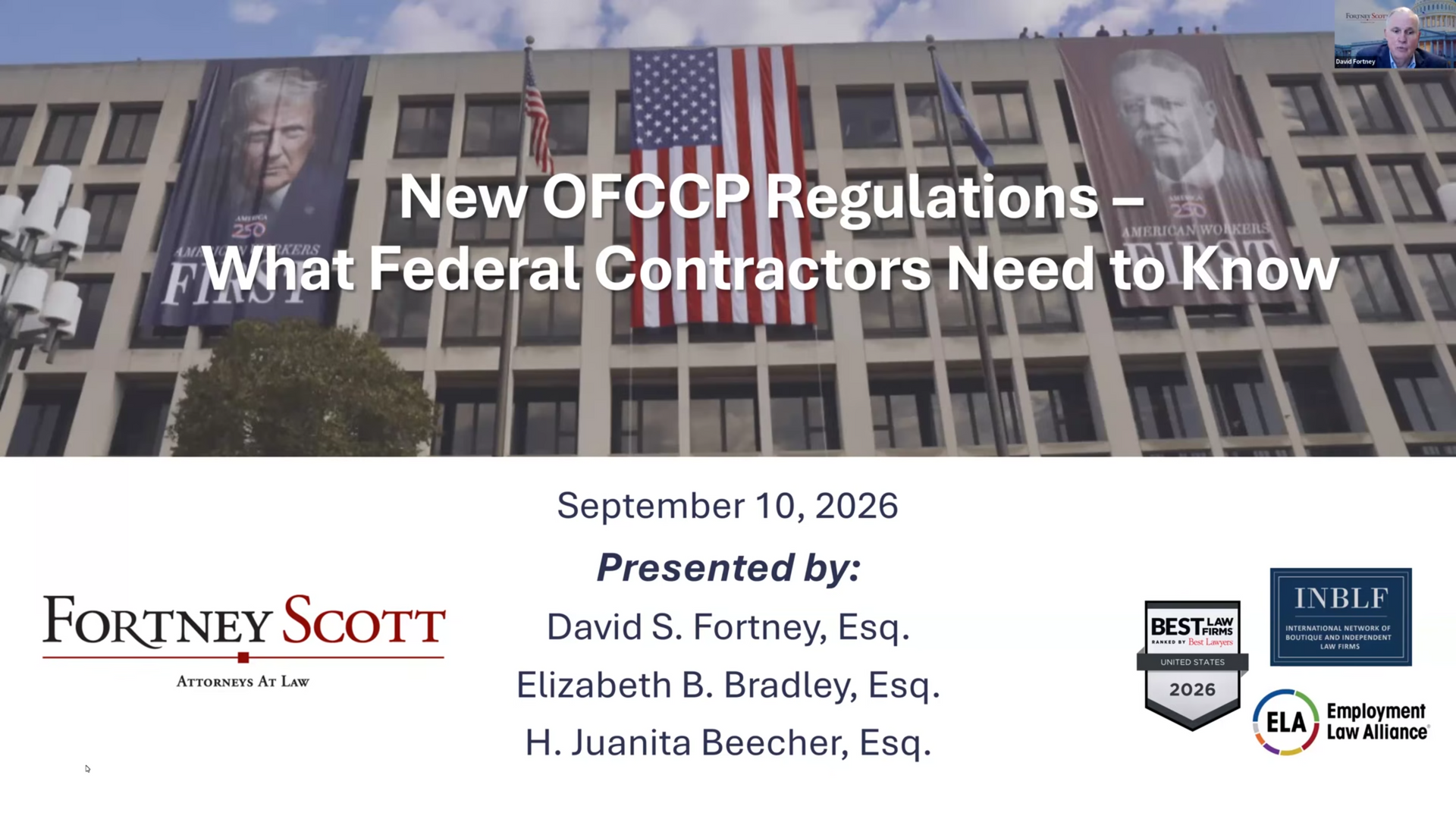
On August 21, 2026, the OFCCP finally published its final rules upending long-standing affirmative action requirements for federal contractors. While the elimination of EO 11246 regulations was expected, the substantial changes to Section 503 were less expected. By September 21, contractors must not only update their systems to remove now banned requirements but also determine how they will meet their affirmative action requirements without data collection. We will break down the most important developments, explain which obligations remain in place, and highlight practical steps organizations can take now to reduce risk, preserve defensible compliance practices, and prepare for what comes next. In this webinar, you will learn how to: Identify the OFCCP changes most likely to affect your affirmative action program strategy; Evaluate how revised Section 503 requirements may affect disability-related data collection, outreach, and documentation; Understand continuing VEVRAA obligations for protected veteran compliance. Manage transition issues for current and upcoming AAP cycles; and Prioritize practical next steps for policies, records, audits, and stakeholder communications.
August 27, 2026
Join FortneyScott attorneys on Thursday, September 10, 2026 from 12:00pm to 1:00pm EDT for a timely and practical webinar on the revised OFCCP regulations and how contractors should respond. To register, click here . On August 21, 2026, the OFCCP finally published its final rules upending long-standing affirmative action requirements for federal contractors. While the elimination of EO 11246 regulations was expected, the substantial changes to Section 503 were less expected. By September 21, contractors must not only update their systems to remove now banned requirements but also determine how they will meet their affirmative action requirements without data collection. We will break down the most important developments, explain which obligations remain in place, and highlight practical steps organizations can take now to reduce risk, preserve defensible compliance practices, and prepare for what comes next. In this webinar, you will learn how to: Identify the OFCCP changes most likely to affect your affirmative action program strategy; Evaluate how revised Section 503 requirements may affect disability-related data collection, outreach, and documentation; Understand continuing VEVRAA obligations for protected veteran compliance. Manage transition issues for current and upcoming AAP cycles; and Prioritize practical next steps for policies, records, audits, and stakeholder communication s. To register for this webinar, please CLICK HERE .
August 20, 2026
The U.S. Department of Labor (DOL) will publish in the Federal Register the three final rules impacting federal contractor regulations on Friday, August 21, 2026.  Executive Order 11246 regulations – DOL finalized the rescission of its regulations for EO 11246, effective October 26, 2026, to eliminate the obligations of federal contractors to prepare affirmative action plans based on race and sex, in addition to nondiscrimination provisions, and additional compliance requirements. This is to align with EO 14373, wherein President Trump rescinded EO 11246. Section 503 of Rehabilitation Act – DOL finalized the elimination of the disability self-identification requirements as well as the 7% utilization goal. In addition, the CC-305 Form will be eliminated. DOL holds that the Americans with Disabilities Act prohibits employers, including federal contractors, from collecting voluntary disability identification from applicants and employees. The nondiscrimination and reasonable accommodation requirements are maintained. Contractors with 50 or more employees and $50,000 or more in contracts will continue to be required to prepare affirmative action plans and to assess their outreach and recruitment. DOL moved the administrative procedures provisions from EO 11246 regulations here. VEVRAA – DOL’s revisions to the VEVRAA regulations were mostly technical, retaining the obligation to provide voluntary self-identification of veterans and to prepare affirmative action plans. DOL added the administrative procedures to these regulations and updated the jurisdictional threshold from $150,000 to $200,000. Please contact your FortneyScott attorney or email us at info@fortneyscott.com for more information.
July 21, 2026
The EEOC voted 2 to 1 on Tuesday, July 21st to issue a Notice of Proposed Rulemaking (NPRM) to rescind the requirement for employers and other covered entities to file an annual report with the EEOC summarizing aggregate data on their employees’ race and sex (reports known respectively as the EEO-1, EEO-2, EEO-3, EEO-4, EEO-5, and EEO-6 reports or EEO Data Reports). This includes the rescission of recordkeeping requirements related to these reports.  The proposal states that the Commission has determined the EEO Reports are inconsistent with equal employment opportunity law, may raise constitutional concerns, and that the collection of data is not narrowly tailored or necessary to enforce anti-discrimination statutes. EEOC determined that the reports, which had been collected since, 1966, have limited value, which was outweighed by the significant burdens they impose on employers and on the Commission. Once the NPRM is published in the Federal Register, individuals will have only 30 days to submit comments on the 60-page proposal. The Institute for Workforce Equality is planning to submit comments. Please contact your FortneyScott attorney or email us at info@fortneyscott.com with any thoughts you have on the proposed rescission, or on employer record-keeping obligations generally.
More Posts