H. Juanita Beecher

H. JUANITA BEECHER

OF COUNSEL

WASHINGTON, D.C.

Tele: (202) 689-1200 | Fax: (202) 689-1209
nbeecher@fortneyscott.com

H. Juanita (Nita) Beecher, Of Counsel to Fortney & Scott, LLC, advises clients on a broad range of employment law issues with her primary focus on issues involving discrimination, affirmative action, compensation, and wage and hour matters. She serves as Legal Counsel for The Institute for Workplace Equality and co-editor of the Federal Employment Law Insider, a monthly newsletter updating employers on federal laws and regulations and presents webinars on federal employment law issues. In addition to her work with U.S.-based employers, she partners with multinational organizations to advise on global pay transparency and pay equity requirements.


Prior to working for FortneyScott, Ms. Beecher served as in-house counsel in major corporations for over 20 years where she advised in-house clients on labor and employment law issues and developed a self-audit tool for OFCCP audits. Ms. Beecher also spent 10 years leading a networks of senior diversity, EEO, and affirmative action corporate practitioners and of one for in-house labor and employment counsel.


In 2011-2012, Ms. Beecher served as one of ten experts on the National Research Council of the National Academies panel which produced the NAS report, Collecting Compensation Data from Employers, requested by EEOC.


Ms. Beecher has been a regular speaker at many professional meetings, including the annual NILG conferences since 2004.

Firm Practices


Professional Activities

  • Member, Academy of Science Expert Study On Measuring and Collecting Pay Information from US Employers by Gender, Race and National Origin
  • Member, American Bar Association, Equal Employment Committee
  • Member, North Carolina Bar Association
  • Member, St. Louis ILG


Admitted to Practice

  • Commonwealth of Pennsylvania
  • District of Columbia 
  • North Carolina 
  • Western District of Pennsylvania


Education

  • University of North Carolina School
    of Law (J.D.); (A.B.)


March 31, 2026
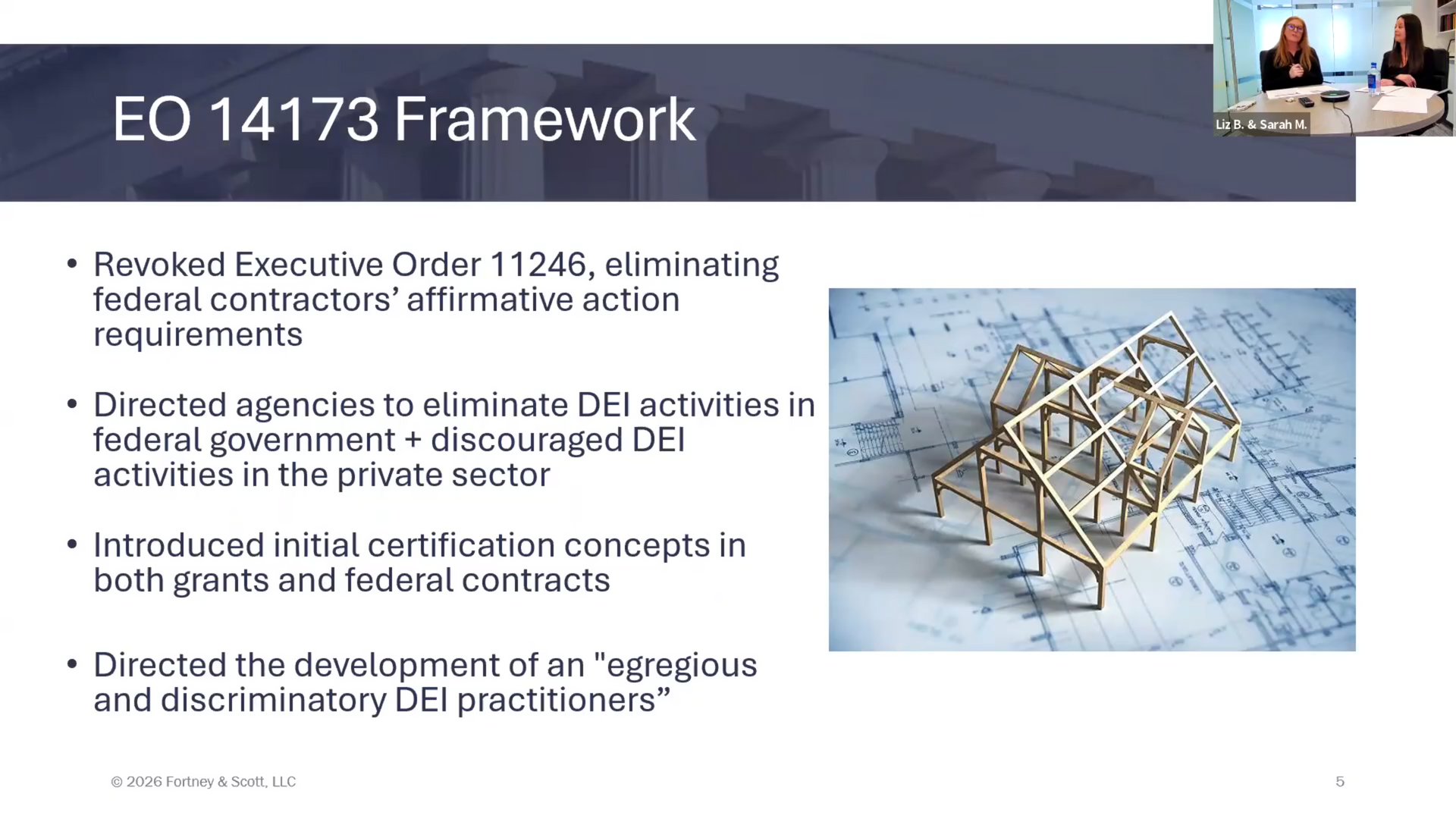
In this special webinar we will address: Details of the new EO; The specific prohibition on “racially discriminatory DEI activities” in five key areas; The new requirements that add materiality to the contract payments and the expansion of the basis for False Claims Act exposure; New subcontractor management and reporting duties; Penalties and enforcement, including contract cancellation, debarment from future contracts and FCA actions by DOJ; and, The detailed implementation deadline for actions, including the new contract clauses, FAR Council guidance and agencies compliance report to the White House.
March 27, 2026
In collaboration with FortneyScott and Fragomen law firms, LRQA officially launched TriAge: Age & Eligibility Verification Framework , designed to help employers strengthen hiring and workforce monitoring amid rising age and eligibility verification risks. TriAge goes beyond basic I‑9 compliance by providing a structured set of best practices to verify identity, age, and eligibility across operations. The framework also supports enhanced oversight and allows for independent validation through audits and assessments. We are proud to have contributed to the development of LRQA’s TriAge, a practical tool that helps employers build stronger, more defensible hiring practices.
March 27, 2026
President Trump issued a new Executive order ( EO 14398 ) on March 26, 2026, entitled “Addressing DEI Discrimination by Federal Contractors,” and accompanying Fact Sheet . The new EO fundamentally alters the compliance landscape for government contractors. While prior executive orders addressed DEI programs through policy directives, this new EO creates a mandatory, enforceable contract clause that exposes contractors to contract termination, debarment, and False Claims Act (FCA) liability. The Core Requirement: A New Mandatory Contract Clause Within 30 days (by April 25, 2026), agencies must insert a specific clause into all covered contracts, subcontracts, and lower-tier subcontracts. By accepting a contract containing this clause, contractors agree to six binding obligations: 1. The contractor will not engage in any “racially discriminatory DEI activities,” as defined in Section 2 of the Executive Order of March 26, 2026 (Addressing DEI Discrimination by Federal Contractors): 2. The contractor will furnish to contracting agencies all information and reports, including providing access to books, records, and accounts, for purposes of ascertaining compliance; 3. In the event of the contractor’s or a subcontractor’s noncompliance with this clause, the government contract may be canceled, terminated, or suspended in whole or in part, and the contractor or subcontractor may be declared ineligible for further Government contracts; 4. The contractor will report any subcontractor’s known or reasonably knowable conduct that may violate this clause to the contracting department or agency and take any appropriate remedial actions directed by the contracting department or agency; 5. The contractor will inform the contracting department or agency if a subcontractor sues the contractor and the suit puts at issue, in any way, the validity of this clause; and, 6. The contractor recognizes that compliance with the requirements of this clause are material to the Government’s payment decisions for purposes of section 3729(b)(4) of title 31, United States Code (False Claims Act). Immediate Action to Meet Deadlines Federal contractors face very short deadlines for the implementation of these new obligations, including the inclusion of the new contracting clauses within 30 days, by April 25, 2026. Federal contractors should initiate steps immediately to ensure compliance, including: 1. Audit Internal Programs: Review mentorship programs, ERGs, leadership development tracks, and supplier diversity initiatives for eligibility criteria based on race or ethnicity. 2. Update Subcontractor Agreements: Immediately begin flowing the mandatory clause down to all subcontractors and establish a monitoring system to satisfy the “known or reasonably knowable” reporting standard. 3. Review Invoicing and Certifications: Ensure that no compliance certifications or payment requests are submitted if prohibited activities exist. For More Information and Assistance Register now for FortneyScott’s special webinar, Federal Contractors’ New DEI Obligations that will be held on Tuesday, March 31, 2026 from 12:00 noon to 1:00 ET. This special webinar we will address: - Details of the new EO - The specific prohibition on “racially discriminatory DEI activities” in five key areas - The new requirements that add materiality to the contract payments and the expansion of the basis for False Claims Act exposure - New subcontractor management and reporting duties - Penalties and enforcement, including contract cancellation, debarment from future contracts and FCA actions by DOJ - The detailed implementation deadline for actions, including the new contract clauses, FAR Council guidance and agencies compliance report to the White House For more information on how federal contractors can comply with this new EO, contact your FortneyScott’s attorney or email us at info@fortneyscott.com .
March 20, 2026
The Trump Administration continues to push for the elimination of “illegal DEI.” Join FortneyScott attorneys on Thursday, April 9, 2026 at noon EDT to learn the latest developments by multiple federal agencies targeting DEI programs and policies. The webinar will address the key federal agencies’ expansive efforts, including: EEOC , focusing on the agency’s latest challenges to DEI, including expansive investigations of corporate DEI programs, subpoena enforcement litigation and limiting the rights of trans workers; DOJ , including the False Claims Act investigations, and challenges to the constitutionality of EO 14173 in 4th and 7th Circuits; FTC & FCC , highlighting the Mansfield Program, and warning law firms about antitrust compliance, and how DEI can impact regulatory approvals; and, Certification of Compliance , including GSA’s proposed Certification for grantees, and the implications for federal contractors. We also will provide key takeaways for DEI compliance, and steps to mitigate the risks of federal government enforcement actions based on illegal DEI matters. This webinar is the final in a three-part series designed for compliance professions, in-house counsel, HR and inclusion leaders, and other business leaders responsible for labor and employment law compliance. To register for FortneyScott’s Workplace Legal Compliance training series, please click here .
March 3, 2026
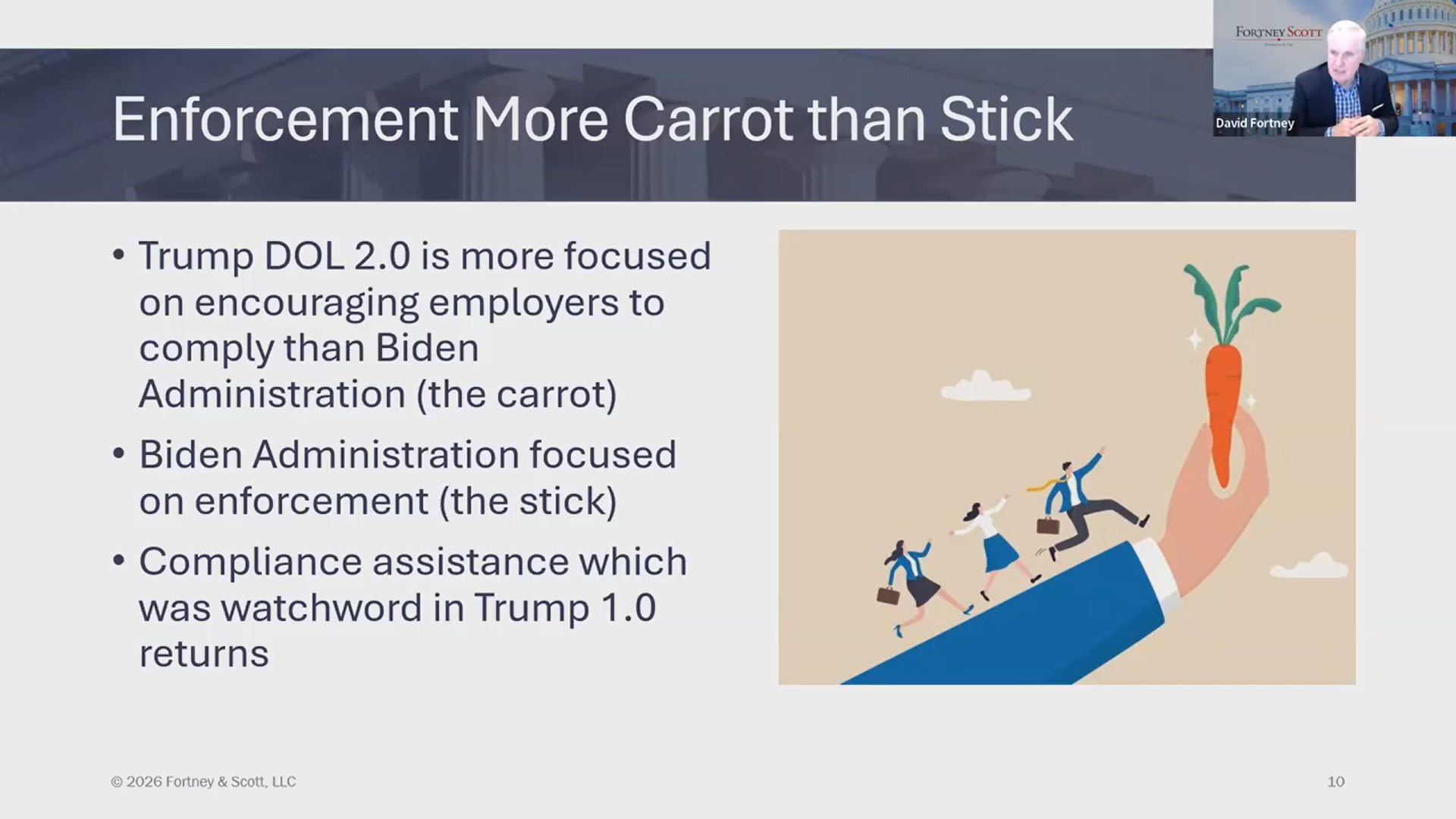
Having been fully funded for FY2026 and with new leadership in place, employers can expect much more from the Department of Labor in the second year of Trump 2.0. Join FortneyScott attorneys on Tuesday, March 3, 2026 at noon EDT to learn DOL’s priorities for 2026 and how to ensure compliance. Key Topics to be Covered Include: Overview of DOL Trump 2.0 officials Budget for FY2026 Next Steps from Wage & Hour Status of regulations PAID Program Return of Opinion Letters Child Labor enforcement FY2025 recovery Project Firewall Joint project with DOJ, EEOC and USCIS over H-1Bs Future of OFCCP – What to expect from the agency now that it has been funded Key Takeaways to ensure compliance This webinar is the second in a three-part series designed for compliance professions, in-house counsel, HR and inclusion leaders, and other business leaders responsible for labor and employment law compliance.
Show More